How to Make a Boring Office Look High-End, Organized and Actually Nice to Work In
Updated: Jul 9
Most offices are designed in roughly this order:
First, someone buys a desk, then a chair and a little while later a printer, that nobody remembers buying, appears. Cables begin reproducing underneath the furniture.
Someone brings in a plant with good intentions and five years later, everyone is sitting under one aggressively bright ceiling light wondering why the office feels slightly depressing.
Whether you're working in a law office, beauty salon, therapy practice, photography studio, estate agency, architecture firm, clinic, tutoring centre, small creative agency or the back office of your own shop, the same basic principles apply:
A good office should be functional, comfortable and organized.
But it should also be somewhere you don't actively resent spending eight hours a day, because "technically has a desk" feels like a fairly low bar.
Disclosure: Some of the products featured in this post are affiliate links. If you decide to purchase through them, I may earn a small commission at no additional cost to you. Thank you for supporting My Iconic Finds ❤️
Start With the Furniture That Dominates the Room

Before buying decorative objects, stand at the entrance of your office and look around.
What is the first thing bothering you?
It might be a row of mismatched chairs or desks that are too small for the work happening on them. I could be a giant filing cabinet that looks like it has survived several corporate mergers.
If it bothers you, start there.
One of the easiest mistakes to make when improving an office is buying small decorative things while ignoring the large pieces making the room feel chaotic.
A new vase cannot save a room from seven visible extension cords.
The desk should suit the person using it. An architect may need room for drawings and samples. A photographer needs space for editing equipment and hard drives. An accountant probably needs more paperwork storage than someone running an online business.
If someone spends most of the day at a computer, a height-adjustable desk can be a genuinely useful upgrade. The COLAMY LumiDesk offers a more flexible workstation base, while its modular design was created to work with accessories for storage, equipment and cable organization.

📌View it here (Discount code AW10 at checkout):
Upgrade the Office Chair

Office chairs tend to fall into two categories:
The first looks nice but feels like sitting on a decorative rock.
The second is apparently very ergonomic but looks like it was removed from the control room of a spaceship.
Thankfully, there is now a much better middle ground.
If you or your employees spend hours sitting every day, the chair is one of the things worth prioritizing. Look for proper support, adjustable features and a seat designed for the amount of time it will actually be used.
But yes, I also think it should look good. I refuse to accept that spinal support and attractive furniture are natural enemies.
This matters even more in smaller offices where the chairs dominate the room visually. A room full of bulky black chairs can make an otherwise bright space feel heavy very quickly.
And this isn't only relevant to people working in corporate jobs. Designers, accountants, online business owners, architects, photographers and salon owners doing their admin at 10 p.m. all deserve somewhere decent to sit. Their lower backs are surprisingly united on this issue.
For long days spent at the same workstation, I like the COLAMY ATLAS. Plenty of adjustability for people who spend hours working at a desk. It makes sense for accountants, designers, architects, editors—or anyone whose quick morning email session somehow turns into looking up and realizing it’s already dark outside.
Feel free to browse their entire collection here: COLAMY
For a lighter, more colourful office, the Sunaofe Resistance is my other pick. It has a much less corporate-looking design and comes in several colours, making it particularly good for creative studios, home offices and businesses where a row of enormous black office chairs would completely change the atmosphere of the room.
Feel free to browse their entire collection here: Sunaofe
Two different chairs for two very different offices. Because the best ergonomic chair isn't necessarily the one with the longest list of features—it's the one that works for the way you work and the room you actually have to look at every day.

📌COLAMY
Best for long working days and maximum adjustability (Discount code AW10 at checkout):

📌Sunaofe
Best for colourful, creative workspaces that still need proper ergonomic support.(Discount code LOVE15 at checkout):
Clear the Desk and Deal With the Cable Situation

Nothing ruins a beautiful desk setup faster than looking underneath it.
Suddenly it's less "calm productive workspace" and more "electrical spaghetti incident."
Cable management is not exciting, but visually it makes a much bigger difference than people expect.
Start by getting power strips off the floor. Under-desk cable trays can hold adapters and excess wire, while adhesive clips can guide charging cables along the underside or back of the desk.
Bundle cables that travel in the same direction and remove chargers or wires nobody actually uses anymore.
For shared offices, meeting rooms and reception desks, this matters even more because clients can often see the back or underside of the furniture.
And if you have a desk positioned in the middle of the room, plan the cable route before falling in love with the layout.
Otherwise you may create the world's most beautiful trip hazard.
📌View some of my organization picks here (Affiliate links below):
If your monitor base is taking up half the desk, a monitor arm is another surprisingly effective upgrade. Apart from freeing up valuable surface space, it lets you adjust the screen position instead of arranging your entire body around wherever the monitor happens to be.
The Sunaofe CTS monitor arm range includes options for single and dual-monitor setups, which makes it useful for anything from a small reception desk to a designer, editor or accountant working across multiple screens.

📌View it here (Discount code AWSUN10 at checkout):
Hide the Ugly Stuff

Open shelving is beautiful, until you actually put office things on it.
Then suddenly you're displaying printer paper, spare toner, tax folders, extension cords, six boxes of business cards and a mysterious collection of cables nobody is brave enough to throw away.
Not everything deserves a moment.
Use open shelving for things that can genuinely look good: books, material samples, beautiful storage boxes, ceramics or carefully arranged work-related objects.
Everything else can be put away.
Closed cabinets make an enormous difference in offices with lots of practical supplies. Beauty professionals have products and tools. Teachers and tutors have books and stationery. Architects and interior designers collect samples. Photographers have equipment. Accountants have paperwork. Soooo much paperwork (I feel for you).
The exact storage system will vary, but the principle is the same: if every practical object is visible at once, the room will always feel busier than it needs to.
And don't buy 46 tiny containers before deciding what actually needs to be stored.
Organizing clutter into smaller, more aesthetically pleasing clutter is still clutter. Sorry.
📌View some of my organization picks here (Affiliate links below):
Create Clear Zones

A polished office usually feels organized because the room has clear zones.
There is a place to work.
A place to store things.
A place to meet clients.
A place to make coffee.
Possibly even a place to eat lunch that isn't directly above the keyboard.
You don't need a huge floor plan to create zones. A rug can define a small client seating area. Open shelving can separate desks from a meeting space. A console table can become a coffee station. Two comfortable chairs can turn an unused corner into a place for informal meetings.
This is particularly useful for professions where one room has to do several jobs.
A therapist may need a desk area and a softer conversation area. A photographer may need an editing station separate from equipment storage. A beauty professional may need a treatment space, a tiny reception zone and somewhere to do admin without balancing a laptop beside a wax heater.
When every activity has a logical place, the entire office feels calmer.
Fix the Lighting

If your office is illuminated by one ceiling panel that makes everyone look like they're being questioned by the authorities, things are bad.
Good office lighting should be practical, but that doesn't mean every corner needs to be equally bright.
Use general lighting for overall visibility, then add focused task lighting where people actually work. Desk lamps can help with paperwork and detailed tasks, while floor lamps, wall lights and picture lights can add a softer layer in reception areas, private offices and client-facing rooms.
Natural light should be used wherever possible, but pay attention to glare on screens. Sometimes moving a desk slightly or adding a light-filtering blind solves a problem everyone has simply been tolerating for three years.
A therapy room, beauty studio or consultation space may benefit from softer ambient lighting, while workstations need more focused light.
The important thing is that the entire office shouldn't rely on one lonely switch by the door.
📌View some of my lighting picks here (Affiliate links below):
Put Something on the Walls

Blank office walls have a special ability to make a business look like it moved in yesterday, even if it moved in nine years ago.
Wall art is one of the fastest ways to give a workplace personality, but I would resist the urge to cover every available surface with motivational quotes.
Large-scale art usually looks more polished than lots of tiny pieces scattered around the room. One oversized piece can transform a reception area, while a thoughtful gallery wall can work beautifully in a creative studio, salon or informal office.
The artwork can relate subtly to the profession without becoming painfully literal.
An architecture studio doesn't necessarily need photographs of buildings.
A dental practice doesn't need giant teeth. (Please)
Instead, think about the atmosphere you want to create. Calm? Creative? Sophisticated? Energetic? Welcoming?
Choose art that supports that feeling.
📌View some if my wall art picks here (Affiliate links below):


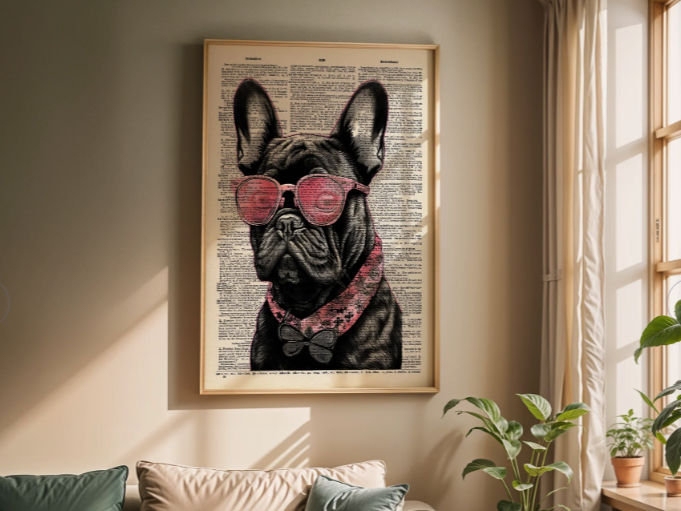
Use Rugs, Colour and Texture to Make It Feel Less… Office-y

One reason offices often feel boring is that everything has the same hard, practical surface. It usualli is laminate desk, plastic chair, metal cabinet, white wall, grey floor.
Congratulations. You have created a room where a stapler would feel emotionally at home. Was this what you really wanted? I doubt it.
A rug can immediately soften a reception area, private office or meeting corner while also helping define the zone.
For busy workplaces, choose something durable and easy to maintain. Low-pile rugs are generally easier around office furniture, while washable options can make sense for smaller businesses where there isn't exactly a professional rug-cleaning team standing by.
Then add some texture and colour.
An upholstered chair, wood furniture, curtains or blinds, a ceramic lamp, fabric-covered acoustic panels in a noisy office.
And yes, offices are allowed to have colour - I checked.
A deep blue chair, warm wood desk, dusty green cabinet or colourful piece of art can give a workplace identity without making it look unprofessional.
A children's tutoring centre can be colourful without becoming chaotic. A therapist's office can feel calm without turning completely beige. A creative studio can handle stronger contrast. A legal or financial office can feel serious without looking like colour has been legally prohibited.
Professional does not mean personality-free. Note this.
Lahome’s washable rugs are a great way to bring colour and pattern into an otherwise plain office without adding something too precious for real life.
You can browse their entire collection here: Lahome

📌View my pick here (Discount code MYICONIC20 for 20% off at checkout): Washable Vintage Botanical Black Rug
Make the Coffee Corner Look Intentional

Every office has a coffee situation - most of us run on it.
The question is whether it's a coffee corner or an archaeological site.
A coffee machine, three different boxes of tea, sugar packets, paper cups, someone's protein powder and a spoon that apparently belongs to nobody do not create a relaxing break area.
You probably don't need a full kitchen renovation.
A small cabinet or console can hold the coffee machine, mugs and everyday supplies. Use a tray to group smaller items and keep backup supplies inside drawers or cabinets.
Then add one or two things that make the area pleasant: a small lamp, artwork, a plant or even just decent mugs.
If clients are offered drinks in your office, this area matters even more.
The coffee corner of a law office may look different from the one in a hair salon or creative studio, but all of them can feel organized and welcoming.
And if the coffee machine sounds like a tractor starting every time a client arrives, perhaps address that too. Interior design can only do so much.
📌View some of my coffee corner picks here (Affiliate links below):
Don't Treat Client-Facing Areas as Leftover Space

If clients visit your workplace, the reception or waiting area is their first impression of the business.
This doesn't mean you need a marble desk, a giant logo illuminated from behind and a receptionist named Cassandra who appears to know everyone's secrets.
It simply means the space should feel intentional.
Think comfortable seating, a small table within reach, good lighting of course, somewhere to put a coat or bag, artwork that doesn't look like it came free with the frame, and a clear path through the room.
For salons, clinics, therapists, consultants, estate agents and other client-facing businesses, even a tiny waiting area can feel polished with the right furniture arrangement.
Avoid lining every chair against the wall if you can. Two chairs angled slightly toward each other with a small table and rug will usually feel more welcoming than four chairs sitting in a straight row like everyone is waiting to renew their passport.
And please sit in the waiting chairs yourself, for ten whole minutes.
You may discover things.
🦌 Elafina Says:
If your office currently feels boring, chaotic or slightly temporary, don't try to fix everything by buying decorations.
Start with the things that affect how the space actually works:
Choose desks that suit the job.
Invest in chairs people can comfortably work in.
Hide the cables.
Create enough storage.
Give different activities their own zones.
Fix the lighting.
Then add the things that make the office feel finished: art, rugs, colour, texture and a coffee corner that doesn't frighten visitors.
The result doesn't need to look like the headquarters of a billion-dollar company (unless you do own a billion-dollar company). It just needs to feel like somebody thought about it.
Because whether you're running a therapy practice, beauty business, architecture studio, accounting firm, photography business, clinic, tutoring centre, estate agency or tiny creative company, your office is more than somewhere to put a laptop.
It's where a significant portion of your life happens, you might as well make it nice.


Comments