Messy Closet? Here’s the Fix That Actually Works
Updated: Aug 31
AKA: why getting dressed feels like a personal attack… and how to fix it in one afternoon.
It’s not your tons of clothes. It’s not your time management. It’s definitely not your discipline.
👉 It’s your closet.
Or, more specifically, it might be the way your closet is organized.
Because right now, your wardrobe may be designed for a calm, organized woman who wakes up early, drinks lemon water and “plans outfits.”
Who even is this woman? Certainly NOT me 🙃
The rest of us are trying to find a bra while holding coffee, checking the time and mentally preparing for life, and that’s exactly why so many traditional closet organization ideas fail. They look beautiful in photos, but they require constant folding, rearranging and general emotional stability to maintain.
A closet that only stays organized when you have 45 spare minutes and a podcast playing is not a functional closet.
So instead of trying to create the world’s most beautiful wardrobe, we’re going to create something better: a closet organization system that still works when you’re tired, late and slightly annoyed.
Let’s fix this. Properly.
If you, however, want to skip to the TL;DR version then jump here: ⬇️
Disclosure: This article contains affiliate links. If you purchase through them, I may earn a small commission at no extra cost to you. Some products featured in this article are part of Amazon Creator Connections campaigns. Thank you for supporting My Iconic Finds ❤️
If You Can’t See It, You Won’t Wear It

Your brain is simple:👉 Visible = exists👉 Hidden = forgotten for 7–10 business months
That perfectly folded T-shirt at the back? Dead to you.
The jeans underneath six other pairs? They had a good life.
One of the biggest causes of a messy closet is simply trying to store too much in the same visual space. Deep stacks, crammed rails and overflowing shelves make it harder to see what you own—and when you can’t see your clothes, you tend to wear the same small group of things repeatedly.
The answer isn't necessarily a bigger wardrobe. It’s better visibility.
Try this:
Stop stacking clothes in deep piles.
Keep folded stacks low enough that removing one item doesn't cause a textile avalanche.
Reduce the number of rows hidden behind each other.
Use matching slim hangers to create more breathing room on the rail.
Move rarely worn and out-of-season clothing away from your prime everyday space.
Use open-front or easy-access storage for the things you reach for constantly.
The goal is this:
You open the door and immediately understand your options.
This is also where a few inexpensive closet organizers can make a genuine difference. Slim velvet hangers are useful for everyday tops, dresses and lighter jackets because they take up less rail space than bulky hangers. A hanging shelf organizer can also add useful vertical storage if your closet has plenty of hanging space but almost no shelving.
For very deep shelves, I also like shelf dividers. They stop stacks of knitwear and jeans slowly merging into one giant fabric ecosystem.
Stop Organizing by Category—Start Organizing by OUTFITS

No one has time to “build outfits” at 7:42 on a weekday morning.
So why is your closet organized like a clothing store?
👉 Tops here
👉 Jeans there
👉 Blazers somewhere else
👉 The belt you need currently missing in action
Organizing everything strictly by clothing category makes sense from a storage perspective, but it doesn’t always make sense for the way we actually get dressed.
The alternative? Create a small ready-to-wear outfit zone.
I’m not suggesting that you pair every single item you own into permanent outfits. That would require an entirely different personality.
Start with five.
For example:
Jeans + white T-shirt + blazer = one ready outfit.
Dress + cardigan = one ready outfit.
Trousers + shirt + lightweight jacket = one ready outfit.
You can hang the pieces together in one small section of your wardrobe or use multi-garment hangers to keep coordinating pieces close to each other.
Now instead of:
“I have absolutely nothing to wear 😩”
You get:
👉 “I’ll take this. Bye.”
If mornings are your particular enemy, add a small garment rail or a few sturdy over-the-door hooks outside the main closet. They’re useful for preparing tomorrow’s outfit without turning your bedroom chair into a temporary branch of Zara.
🔥 Hot tip: Start with only five outfits. You don’t need 30 pre-planned looks. Five genuinely wearable combinations can remove a surprising amount of weekday decision fatigue.
The System Has to Be LAZY-Proof (or it will fail)

If your closet organization system requires:
folding like Marie Kondo,
colour coding,
carefully rolling every sock,
transferring every object into a tiny matching container,
emotional stability...
…it’s not going to last and you know it. We ALL know it.
The best closet organization system is not necessarily the prettiest one.
It’s the one you will actually maintain.
For me, that means baskets and bins for categories that don't need perfect folding.
Think:
gym clothes,
pyjamas,
scarves,
soft knitwear,
swimwear,
tote bags,
belts,
random clothing accessories that otherwise migrate around the bedroom.
A set of fabric storage cube bins works well on open shelving, while pull-out closet baskets make deep shelves easier to use. If your wardrobe has a lot of wasted vertical space, stackable shelf organizers can create an extra level without changing the closet itself. And no, every basket does not need a beautifully calligraphed label.
If you know where your pyjamas live, we're done here.
👉 We are not creating a showroom.👉 We are creating a functional survival zone.
The easier it is to put something away, the more likely you are to actually do it. That is the entire philosophy.
"The Chair" Is Not the Problem (Your System Is)

Every home has the chair. You know the one.
The clothes on it are neither clean nor dirty, so it's easy to just pretend they're not there, instead of facing the fact you have to do something about it.
Here’s the thing: the chair pile exists for a reason.
Most traditional closet systems only give clothes two possible states:
Clean and inside the closet OR Dirty and inside the laundry basket.
But what about the jeans you wore for three hours?
The cardigan you might wear again tomorrow?
The blazer that is definitely not dirty enough to wash but somehow feels wrong hanging beside your freshly laundered shirts?
Exactly.
We’re not removing the chair concept. We’re upgrading it.
Create a dedicated WORN ZONE for clothes that:
you've worn once,
you plan to wear again,
don't belong in the laundry yet,
and don't feel ready to go back into the main wardrobe.
Your worn zone could be a row of minimal wall hooks, a small freestanding clothing rail, an over-the-door hanging rack, or a large open basket specifically for in-between clothes.
Personally, I think a large basket is the easiest solution for soft items, while hooks work better for jeans, cardigans and shirts that you don't want crushed.
The important thing is that the zone has a limit.
If your “worn zone” becomes a second wardrobe containing 47 items and a coat you last wore in February, we have simply invented another chair.
The 10-Minute Reset That Saves Your Sanity

This is where most organization systems fail. You are not required to do a complete closet reset every day, so pleaseeee take that pressure off yourself, make a cuppa and read on.
Your new rule:
👉 Ten minutes. That’s it.
Set a timer if you need to.
During those ten minutes:
rehang the clothes you want to keep wearing,
put dumpable items back into their baskets,
return shoes to roughly where they belong,
move dirty clothes to the laundry basket,
clear your WORN ZONE if it’s starting to become its own ecosystem,
prepare one outfit for tomorrow.
No deep cleaning.
No reorganizing your entire summer wardrobe.
No suddenly deciding that 9:30 p.m. on a Tuesday is the perfect time to evaluate your relationship with every handbag you've owned since 2014.
Just reset the visible chaos.
A divided laundry hamper can help here if sorting laundry is one of the things that causes clothes to pile up. An over-the-door organizer is also useful for smaller accessories that tend to create visual clutter: scarves, belts, small bags and other things that somehow never have a home.
The goal of the ten-minute reset is simple:
👉 Tomorrow-you shouldn't hate today-you.
That's enough.
The Only Rule That Actually Matters
If your closet organization system only works when you're:
motivated,
rested,
in a good mood,
listening to an organizing podcast,
and mysteriously have no children asking you questions...
👉 It’s not a system. It’s a fantasy.
Your closet should work when you're:
late,
tired,
distracted,
already annoyed,
and trying to get dressed in six minutes.
Because that's real life.
When you're deciding how to organize a messy closet, don't ask:
“What would look the most beautiful?”
Ask:
“What is the easiest possible way for me to put this item away?”
That question will tell you whether you need a hanger, a hook, a basket, a drawer divider or simply fewer things in one space.
A good closet organization system should remove decisions, not create more of them.
➡️ Closet Survival Kit:
The Items That Will Save Your Sanity And Help Maintain And Organized Closet
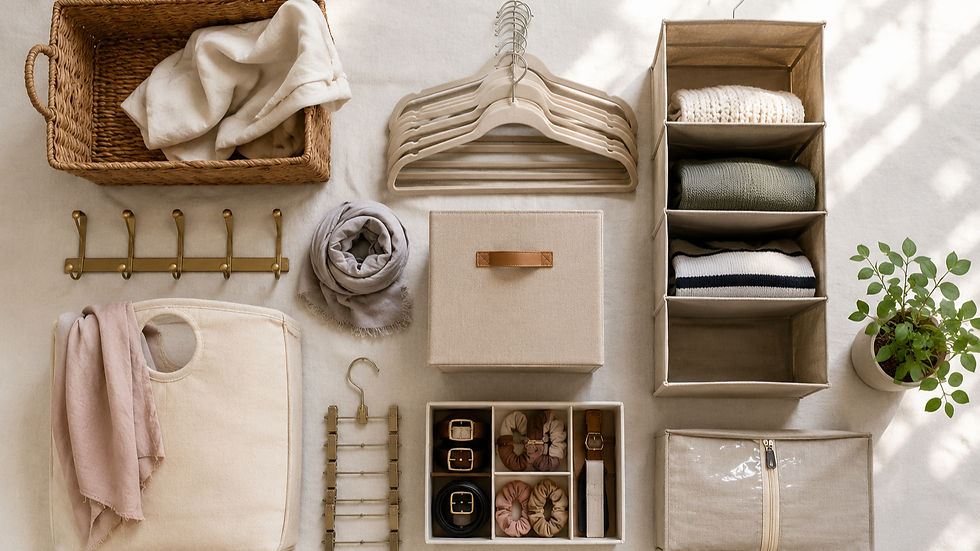
Slim Velvet Hangers — For increasing hanging space and improving visibility.
Shelf dividers — for stopping knitwear, jeans and handbags from collapsing into each other.
Fabric Storage Cube Bins — for gym clothes, pyjamas and soft items that don't need perfect folding.
Large woven or structured fabric basket — for the WORN ZONE and the chair situation.
Hanging closet shelf organizer — for wardrobes with plenty of rail space but very few shelves.
Foldable fabric storage organizers — for seasonal clothes and less frequently used items.
Over-the-door hooks or rack — for tomorrow's outfit and once-worn clothing.
Multi-garment hangers — for keeping pre-planned outfits together.
Stackable shelf organizers — for creating another level of storage on tall wardrobe shelves.
Drawer dividers — for underwear, socks, belts and small accessories.
Under-bed storage bags — for moving seasonal clothes out of valuable everyday closet space.
Divided laundry hamper — for stopping dirty clothes from becoming part of the bedroom floor decor.
Gament rails — for planning outfits ahead, creating a dedicated “worn once” zone, or adding extra hanging space
🦌 Elafina Says:
If you're only going to follow one rule, let it be this:
Create five ready-to-wear outfits and hang them together. That's it.
That one small change can:
save time in the morning,
reduce decision fatigue,
help you actually wear more of your clothes,
and dramatically reduce the daily “I have nothing to wear” spiral.
Your closet doesn't need to look like Pinterest, it just needs to stop fighting you every morning.


Comments