Mid-Century Modern Decor: The Timeless Style That Never Goes Out of Fashion
Updated: Jul 30
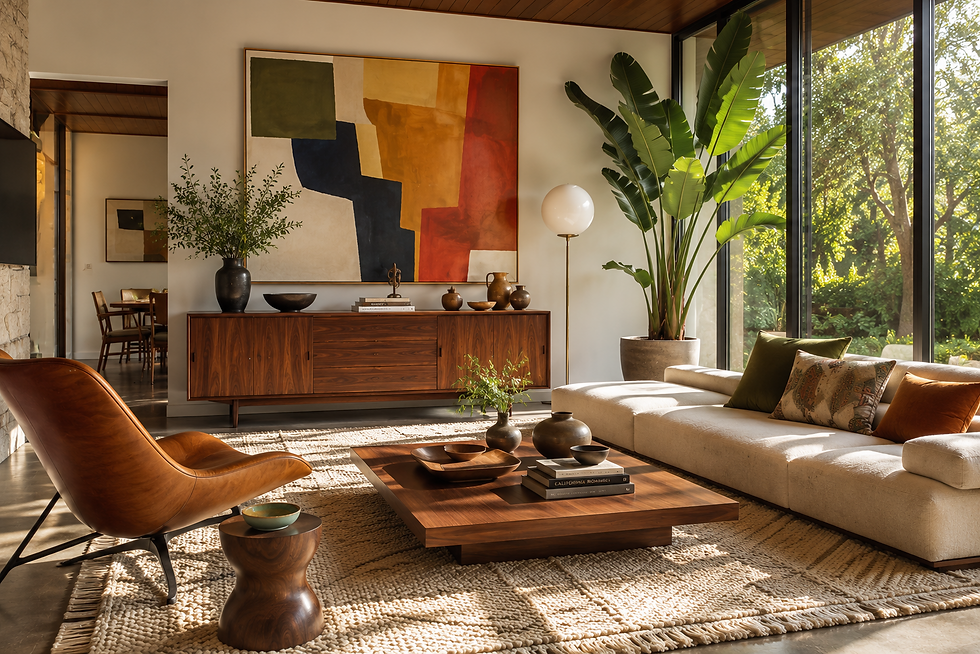
✅Clean lines
✅Warm wood
✅Furniture that somehow looks just as stylish today as it did 70 years ago.
Every few years, someone confidently declares that Mid-Century Modern is "over."
Then another walnut sideboard appears on Pinterest. A sculptural lounge chair steals the show in an Architectural Digest home tour. A Palm Springs house goes viral. Suddenly, everyone is searching for tapered legs and globe lamps again.
The truth is that Mid-Century Modern never really left and in my opinion it never truly will.
Unlike trends that burn bright and disappear, this style has quietly stood the test of time. It feels warm without being cluttered, minimal without being cold, and elegant without trying too hard. That's probably why homeowners, interior designers and furniture brands keep coming back to it decade after decade.
Whether you're decorating an entire house or simply wondering if that beautiful walnut coffee table belongs in your living room (spoiler: it probably does), this guide will show you exactly what makes Mid-Century Modern so iconic—and how to bring the look into your own home.
Let's travel back to the era that changed furniture forever.
Disclosure: Some of the products featured in this post are affiliate links. If you decide to purchase through them, I may earn a small commission at no additional cost to you. Thank you for supporting My Iconic Finds ❤️
Where Did Mid-Century Modern Come From?

Despite the name, Mid-Century Modern isn't one specific year—it's a design movement that flourished roughly between 1945 and the late 1960s.
After World War II, life was changing quickly. Families wanted practical homes, new materials were becoming widely available, and designers were rethinking how furniture should look and function.
Instead of heavy, decorative pieces, they embraced simplicity.
Furniture became lighter.
Rooms became brighter.
Homes started connecting more naturally with gardens and outdoor spaces.
Good design was no longer reserved for luxury homes—it was becoming part of everyday life.
🛒Quick Shop
Want the look without reading the whole guide?
The MYICONICFINDS 30-Second Summary
If someone asked you to describe Mid-Century Modern in one breath, here's your cheat sheet:
Clean, simple lines
Functional furniture that actually makes sense
Warm natural wood like walnut and teak
Furniture raised on elegant legs
Organic curves mixed with geometric shapes
Large windows and natural light
Quality over quantity
Minimal clutter
Think of it as minimalism's warmer, friendlier cousin.
The Design Icons Who Defined Mid-Century Modern
Here's the thing.
You don't have to know the names behind Mid-Century Modern to appreciate the style.
But once you do...
...you'll start noticing their influence absolutely everywhere.
Charles & Ray Eames

If Mid-Century Modern had a power couple, this would be it.
Charles and Ray Eames believed that good design should solve problems—not just look pretty.
Their experiments with moulded plywood completely changed furniture design, and their famous lounge chair is still one of the most recognisable chairs ever created.
Even today, thousands of "Eames-inspired" chairs are sold every year because the original idea was simply that good.
Signature designs include:
Moulded plywood furniture
The iconic Eames Lounge Chair
Comfortable furniture that looked sculptural
Eero Saarinen

Ever seen a dining table with one elegant pedestal instead of four legs?
You can thank Eero Saarinen.
His famous Tulip Table removed what he called the "slum of legs" underneath traditional tables and chairs.
Seventy years later...
...it still looks futuristic.
Signature designs include:
Tulip Tables
Pedestal chairs
Beautiful flowing curves
Florence Knoll

While many designers focused on individual furniture pieces, Florence Knoll transformed entire interiors.
She believed every piece should work together instead of competing for attention.
Many of today's open-plan offices—and even modern homes—still follow principles she introduced decades ago.
Signature designs include:
Elegant office interiors
Clean architectural planning
Functional furniture layouts
George Nelson

George Nelson proved that practical didn't have to mean boring.
His playful clocks, benches and storage pieces brought personality into modern homes without adding clutter.
If you've ever admired one of those quirky starburst clocks...
...you're already a George Nelson fan.
Signature designs include:
Starburst clocks
Clever storage furniture
Playful modern accessories
Harry Bertoia

While many Mid-Century designers worked with wood, Harry Bertoia took an entirely different approach.
Originally trained as a sculptor, he transformed industrial steel into elegant furniture that looked almost impossibly light. His iconic wire chairs proved that furniture could feel delicate without sacrificing comfort, while the intricate shadows they cast became part of the design itself.
Today, Bertoia's work remains one of the most recognizable symbols of Mid-Century Modern, seamlessly fitting into both vintage homes and contemporary interiors.
Signature designs include:
Diamond Chair
Bird Chair and Ottoman
Wire Side Chair
Wire Bar Stool
Sculptural wire furniture collections
Isamu Noguchi

Artist, sculptor and designer, Isamu Noguchi believed furniture should be as beautiful as sculpture.
His work introduced a softer, more organic side to Mid-Century Modern, blending Japanese craftsmanship with modern design principles. Rather than relying on decoration, he let simple forms, natural materials and perfect proportions do all the talking.
His timeless creations continue to inspire designers today, proving that the simplest objects are often the hardest to improve.
Signature designs include:
Noguchi Coffee Table
Akari Paper Lamps
Cyclone Table
Freeform Sofa
Sculptural stone furniture
Hollywood Couldn't Get Enough

Mid-Century Modern wasn't just popular with designers, Hollywood fell in love with it too.
As California architecture exploded in popularity during the 1950s and 60s, celebrities began filling their homes with sleek furniture, open spaces and walls of glass overlooking swimming pools.
Palm Springs quickly became the unofficial capital of Mid-Century Modern living.
Names like Frank Sinatra, Elvis Presley and Steve McQueen all embraced the style, helping turn it into a symbol of effortless sophistication.
Fast-forward to today and it's still everywhere.
The TV series Mad Men introduced an entirely new generation to Mid-Century interiors, while countless boutique hotels, luxury homes and Pinterest boards continue borrowing ideas from the era.
Turns out, timeless design has a habit of staying relevant.
Why We're Still Obsessed With It
Some decorating trends ask you to completely reinvent your home every few years.
Mid-Century Modern doesn't.
Its popularity has lasted because it's built around ideas that never go out of style:
Beautiful craftsmanship
Practical furniture
Honest materials
Comfortable living
Simple shapes
Rooms that feel calm instead of crowded
And perhaps that's the biggest secret of all.
Mid-Century Modern is about choosing pieces that deserve their place in your home.
Or, to put it the MYICONICFINDS way...
If every piece in your room is screaming for attention, none of them are being heard.
10 Rules Every Mid-Century Modern Home Follows

Creating a Mid-Century Modern home isn't about hunting down expensive vintage furniture or turning your living room into a 1960s time capsule.
In fact, the best Mid-Century interiors feel surprisingly current.
Follow these ten principles, and you'll capture the look without making your home feel like a museum.
1. Warm Wood Is Always the Star
Forget glossy white cabinets and ultra-dark espresso finishes.
Mid-Century Modern loves wood that feels natural, rich and full of character.
Walnut is the undisputed favourite, but teak, oak and rosewood also play starring roles. Rather than hiding the grain, designers celebrated it, allowing the natural beauty of the wood to become part of the décor.
Look for:
Walnut furniture
Teak sideboards
Oak dining tables
Matte finishes
Visible wood grain
✅ Elafina’s Tip
If you can only invest in one piece, make it a beautiful walnut sideboard. It'll probably outlive your television.
2. Furniture Should Look Light, Not Heavy
One of the easiest ways to recognise Mid-Century furniture?
The legs.
Instead of bulky pieces that sit directly on the floor, sofas, cabinets and chairs are lifted on elegant tapered legs, making rooms feel brighter and more spacious.
It's a surprisingly simple trick that still works beautifully in smaller homes today.
Choose furniture with:
Slim wooden legs
Raised cabinets
Open space underneath
Clean silhouettes
Minimal visual weight
3. Curves Make the Room Feel Human
Although Mid-Century Modern loves clean lines, it also knows when to soften them.
Rounded coffee tables.
Curved lounge chairs.
Arched floor lamps.
Oval mirrors.
These gentle shapes stop a room from feeling too rigid and create a much more inviting atmosphere.
Easy ways to introduce curves:
Round mirrors
Kidney-shaped coffee tables
Curved accent chairs
Rounded lighting
Circular rugs
4. Lighting Is Meant to Be Admired
Lighting isn't just functional here.
It's art.
Many of the era's most famous light fixtures are still being produced today because they instantly become the focal point of a room.
Think oversized arc lamps stretching over a sofa, dramatic Sputnik chandeliers above dining tables or elegant globe pendants that almost look like floating sculptures.
Classic Mid-Century lighting includes:
Arc floor lamps
Globe pendants
Sputnik chandeliers
Cone-shaped table lamps
Brass finishes
✅ Elafina’s Tip
If guests comment on your lamp before your TV, you've probably done something right.
5. The Colour Palette Feels Warm and Earthy
Mid-Century Modern isn't afraid of colour.
It simply chooses colours that feel grounded.
Instead of bright neon shades or icy greys, you'll find earthy tones inspired by nature, paired with plenty of warm neutrals.
Signature colours include:
Olive green
Mustard yellow
Burnt orange
Rust
Terracotta
Walnut brown
Cream
Charcoal black
The result feels cosy, sophisticated and surprisingly timeless.
6. Every Room Needs One Great Chair
The era gave us some of the most famous chair designs in history for a reason.
A well-designed chair isn't just somewhere to sit—it's a sculpture you can actually use.
Whether it's an iconic lounge chair, a curved accent chair or a sleek dining chair, one beautiful seat often has more impact than five average ones.
Look for chairs with:
Wooden frames
Curved backs
Leather or textured fabric
Tapered legs
Simple silhouettes
7. Art Should Be Bold Enough to Hold Its Own
Tiny artwork floating on a giant wall?
That's a hard no.
Mid-Century Modern embraces oversized pieces that become part of the architecture of the room.
Abstract paintings, geometric prints, vintage travel posters and large black-and-white photography all work beautifully.
The key is confidence.
One large statement piece usually beats a collection of tiny frames.
Artwork that fits the style:
Abstract art
Geometric prints
Vintage posters
Oversized photography
Graphic black-and-white pieces
8. Bring the Outdoors Inside
Mid-Century homes blurred the line between inside and outside long before it became trendy.
Large windows filled rooms with daylight, while greenery softened the clean architecture.
Even if your home doesn't overlook Palm Springs, adding a few carefully chosen plants instantly makes the style feel more authentic.
Our favourites:
Rubber plant
Bird of Paradise
Monstera
Snake plant
Fiddle Leaf Fig
9. Every Piece Should Earn Its Place
One of the biggest lessons Mid-Century Modern teaches us is restraint.
Instead of filling every corner, focus on choosing fewer pieces that do their job beautifully.
A sideboard stores dinnerware.
A coffee table anchors the seating area.
A media unit hides the chaos.
Everything has a purpose.
Prioritise furniture that offers:
Hidden storage
Smart organisation
Timeless design
Everyday functionality
Long-lasting quality
✅ Elafina’s Tip
If you're buying something purely because you don't know what else to put in that corner... don't.
10. Decor Is the Finishing Touch—Not the Main Event
This might be the hardest rule to follow.
When a room starts coming together, it's tempting to keep adding more.
Another vase.
Another candle.
Another decorative object.
Then another.
Mid-Century Modern reminds us that empty space is part of the design.
Instead of dozens of small accessories, let beautiful furniture, natural materials and carefully chosen artwork do the talking.
Less clutter. More impact.
And remember...
Your home should look like someone actually lives there—not like a furniture showroom where nobody is allowed to touch the sofa.
6 Mid-Century Modern Mistakes That Can Ruin the Look
Even the most beautiful furniture can't save a room if a few common mistakes sneak in.
The good news? They're all easy to fix.
1. Buying a Matching Furniture Set
Walking into a furniture store and buying the entire display might be convenient...
...but it's also one of the fastest ways to create a room with zero personality.
Mid-Century Modern interiors evolved over time. They mix materials, textures and shapes instead of looking like everything arrived in the same delivery truck.
Instead:
✔ Mix wood tones carefully.
✔ Combine old and new pieces.
✔ Let each item have its own personality.
2. Going Too "Retro"
There's a fine line between timeless...
...and looking like you've accidentally wandered onto the set of a 1962 sitcom.
A few vintage-inspired pieces add character.
Filling every corner with record players, rotary phones, atomic prints and novelty décor? That's costume design, not interior design.
The goal isn't to recreate the 1950s.
It's to borrow the best ideas from them.
3. Forgetting Texture
Minimal doesn't mean boring.
If your room only has smooth wood and white walls, it can quickly feel flat.
Layer in texture through:
Wool rugs
Linen curtains
Bouclé chairs
Leather accents
Natural stone
Woven baskets
Texture adds warmth without adding clutter.
4. Choosing the Wrong Artwork
We've said it before, but it's worth repeating.
Tiny artwork almost always gets lost.
Mid-Century Modern loves confidence.
One oversized abstract canvas usually creates a far bigger impact than six small frames fighting for attention.
When in doubt...
Go bigger.
5. Filling Every Empty Corner
Not every space needs a plant.
Or a lamp.
Or a basket.
Or a decorative ladder.
Sometimes the most luxurious thing in a room is the breathing space between beautiful objects.
Think of empty space as part of the design—not something that needs fixing.
6. Prioritising Trends Over Quality
One of the reasons Mid-Century Modern has lasted for decades is because it was never built around trends.
People invested in pieces they expected to keep.
So before buying another "must-have" item because everyone's posting it on social media, ask yourself one question:
Will I still love this in ten years?
If the answer is yes...
It's probably a good purchase.
Can You Mix Mid-Century Modern With Other Styles?
Absolutely—and honestly, that's where the magic often happens.
Today's homes rarely stick to just one decorating style, and Mid-Century Modern is surprisingly easy to pair with others.
Mid-Century Modern + Scandinavian ⭐⭐⭐⭐⭐
Probably our favourite combination.
Scandinavian design brings soft neutrals, light woods and cosy textures, while Mid-Century adds richer walnut tones and sculptural furniture.
The result feels warm, calm and effortlessly stylish.
Mid-Century Modern + Japandi ⭐⭐⭐⭐⭐
If you love simplicity, this pairing is hard to beat.
Both styles celebrate craftsmanship, clean lines and natural materials.
The only real difference is that Japandi tends to be quieter and more restrained, while Mid-Century is a little bolder with colour and furniture shapes.
Mid-Century Modern + Organic Modern ⭐⭐⭐⭐☆
One of the biggest decorating trends right now.
Organic Modern softens Mid-Century's crisp geometry with earthy colours, textured fabrics and more relaxed styling.
It's an easy way to make the look feel fresh without losing its character.
Mid-Century Modern + Contemporary ⭐⭐⭐⭐☆
Modern architecture and Mid-Century furniture are a natural match.
Think large windows, open layouts, simple colour palettes and one or two iconic furniture pieces doing all the heavy lifting.
Shop My Mid-Century Modern Recommendations
Looking for even more inspiration? I've gathered my favorite Mid-Century Modern furniture, lighting, rugs, décor and accessories into one easy-to-browse Amazon storefront.
🛒 Designer Picks
Explore my favourite contemporary pieces that reinterpret the timeless spirit of Mid-Century Modern.
COLAMY - Use discount code AW10 at checkout for 10% off.

Mid-century dining chairs in walnut & cream 
Swivel Chair with Tufted Back 
Fluted 6-Drawer Storage Cabinet in Walnut 
Dining Table with NOYA Dining Chairs Set for 4-6 in Walnut
BIG Wall Décor - Use discount code ICON20 at checkout for 20% off.

Mid-Century White California Dreaming Collection by Philippe HUGONNARD 
Palm Flight Palm Tree Wall Art by Kane C. Andrade 
Sandy Coastal Dreams California Dreaming Collection by Philippe HUGONNARD 
Motel 66 Palm Springs California Dreaming Collection by Philippe HUGONNARD 
Palm Springs Pool Day California Dreaming Collection by Philippe HUGONNARD
Poster Master

Soft Abstract Forms by Mareike Böhmer 
Henri Matisse - Blue Nude II No2 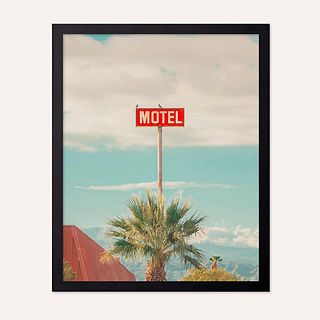
Desert Motel Sign by Tom Windeknecht 
Bauhaus - Rainbow Knots
Lahome - Use discount code MYICONIC20 at checkout for 20% off.

Enfys Washable Rainbow Easy Jute Black/Beige Indoor/Outdoor Rug 
Darrell Washable Abstract Rainbow Stripe Orange/White Rug 
Mirae Washable Vintage Persian Dark Green Rug
Interior Moderna

Marshmallow Sofa 
Mireva Table Lamp 
Amber Orbit Lamp 
Naked Elegance Parametric Wood Carving 
Convex Glow Mirror | Bronze Halo
🪄Mid-Century Modern Inspiration Gallery
Theory is great. Gorgeous rooms are even better. Here's a collection of inspiring interiors packed with ideas you can recreate in your own home, whether you're starting from scratch or simply adding one iconic piece at a time.
Sunlit Living - The kind of living room that proves timeless design never goes out of style. Walnut Craftsmanship - Beautiful materials never need to shout. Evenings Worth Staying In - When architecture becomes the coziest part of the conversation. The Reading Corner - One chair. One book. Hours you'll never get back. Cocktail Hour - Designed for slow evenings, good music and even better company. Bringing the Outdoors In - Mid-Century Modern was never afraid of a little jungle. The chair you'll accidentally spend your entire evening in. Morning Light - Breakfast somehow tastes better surrounded by walnut and sunshine. Wake Up Here - Every morning should begin with this much natural light. The Heart of the Home - Where the kitchen quietly steals the show. Creativity Starts Here - A workspace that makes you want to start your next project. Spa, Mid-Century Style - Natural materials, soft light and zero unnecessary clutter. A Quiet Sunday - Coffee, books and nowhere else to be. The Designer's Desk - Where great interiors begin—with ideas, materials and a sharp pencil. Iconic Lighting - Good lighting isn't decoration—it's architecture. Architecture in Motion - Even the staircase deserves its own moment. Indoor–Outdoor Living - When the garden feels like another room of the house. Rainy Day Comfort - Proof that Mid-Century Modern feels just as magical in the rain.
Frequently Asked Questions
Is Mid-Century Modern still in style?
Absolutely. In fact, it's one of the few decorating styles that has remained consistently popular for decades. While colour palettes and accessories evolve, the core principles of Mid-Century Modern continue to influence contemporary interiors around the world.
Is Mid-Century Modern expensive?
Original vintage furniture can be very expensive, but achieving the look doesn't have to be.
Many retailers now offer beautifully designed Mid-Century-inspired furniture at much more accessible prices.
What's the difference between Mid-Century Modern and Scandinavian design?
Both styles value simplicity and functionality.
Scandinavian interiors tend to use lighter woods and softer neutral colours, while Mid-Century Modern often introduces richer walnut tones, bolder accent colours and more sculptural furniture.
Can I use Mid-Century Modern in a small apartment?
Definitely.
Its clean lines, raised furniture and uncluttered layouts often make smaller spaces feel larger rather than more crowded.
What colours work best?
Some classic favourites include:

Does everything have to be wood?
Not at all.
Wood is the foundation, but Mid-Century Modern also embraces leather, brass, glass, marble, ceramic and textured fabrics.
The key is balance.
Can I mix Mid-Century Modern with antique furniture?
Yes—as long as the proportions and colours work together.
Mixing styles thoughtfully often creates a home that feels more personal and collected over time.
🦌 Elafina Says:
There's a reason Mid-Century Modern has outlived countless decorating trends and that's because tt isn't built around chasing what's fashionable.
It's built around thoughtful design, rooms that feel comfortable, furniture that works beautifully and materials that age gracefully.
Follow these tips and your home will still look inviting years after the latest trend has come and gone.
You don't need an original Eames Lounge Chair.
You don't need to move to Palm Springs.
And you certainly don't need to replace everything you already own.
Start with one timeless piece.
Add another when the time feels right.
Choose quality over quantity.
And remember...
The best Mid-Century Modern homes don't look like they've been copied from a catalogue. They look like they've been collected by someone with great taste, a little patience, and the confidence to let good design speak for itself.


Comments